
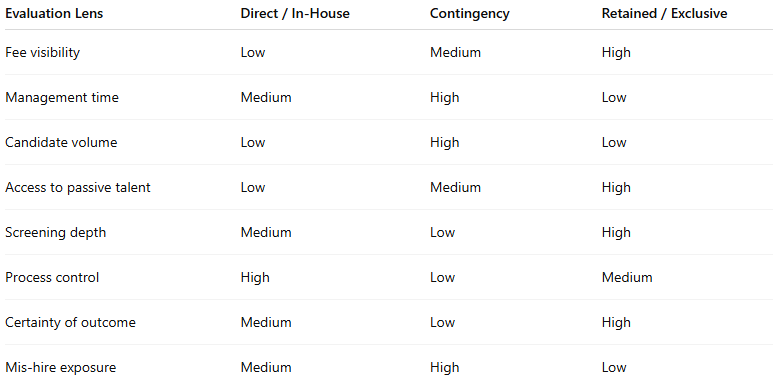
Table illustrates the key consideration by recruitment model
Direct / In-House
What it is
Hiring through internal promotion, succession planning or in-house recruitment teams using direct sourcing and inbound applicants.
What it optimises for
Cost control
Cultural continuity
Speed for familiar roles
Where it works best
Developmental or step-up roles
Well-defined and repeatable positions
Organisations with strong succession planning
Markets with healthy candidate supply
Trade-offs to be aware of
Limited access to external or passive talent
Internal bias towards known quantities
Capability gaps may be masked rather than solved
Internal teams are often stretched on senior roles
When it struggles
Specialist or scarce skillsets
Roles requiring external perspective
Situations where confidentiality matters
In summary
Internal hiring is a cost-efficient and continuity-led model. It works best when the organisation already has the capability it needs or the time to develop it.
2. Contingent
What it is
You only pay if a hire is made. The recruiter carries the financial risk and that cuts both ways.
What it optimises for
Speed
Market coverage
Optionality
Where it works best
Replaceable or operational roles
Clearly defined skillsets
Time-pressured vacancies
Trade-offs to be aware of
High CV volume, lower signal
Limited incentive to challenge the brief
Increased interview load for hiring managers
When it struggles
Senior finance roles
Scarce skillsets
Confidential hires
In short
Contingent recruitment is volume-led and works when urgency outweighs the cost of rework.
3. Retained
What it is
An exclusive search where you pay for a defined process, not just the outcome.
What it optimises for
Certainty
Depth of assessment
Alignment between role, candidate, and business
Where it works best
Business-critical finance roles
Specialist and leadership positions
Situations where the cost of error is high
Trade-offs to be aware of
Higher upfront investment
Requires engagement from all key stakeholders
Smaller but more deliberate shortlists
When it struggles
Roles where speed is the only priority
Unclear or constantly shifting briefs
In short
Retained recruitment is a risk-reduction model and trades volume for confidence.
4. Executive
What it is
A structured, research-led search focused on senior, often passive finance leaders.
What it optimises for
Access to hard-to-reach talent
Confidentiality
Long-term leadership impact
Where it works best
CFO, CFO-1, and senior leadership roles
Succession planning
Board-level appointments
Trade-offs to be aware of
Time investment upfront
Fewer visible early outputs
Requires trust and alignment
When it struggles
Roles with low strategic impact
Situations driven purely by speed or cost
In short
Executive search is a strategic hiring model and it is designed for roles where leadership quality and credibility matter most.
No One Model Is “Best”
Each route optimises for a different constraint:
Internal talent → cost and continuity
Contingent → speed and flexibility
Retained → certainty and quality
Executive search → impact and leadership fit
The mistake isn’t choosing one over another. It’s applying the same model to every vacancy.
A Simple Decision Lens
Before engaging anyone, ask:
What is the cost of this role being wrong for 12–18 months?
How much senior time can this process realistically consume?
Is speed or certainty the bigger risk?