
Most Hiring Problems Start Before the Vacancy Goes to Market
When recruitment fails, the usual explanations appear quickly. “There aren’t any good candidates.” “The market’s tough.” “We need to pay more.” “The agency is rubbish.”
In reality, most hiring problems are created much earlier. They begin with a quiet assumption that every vacancy should be taken to market in the same way. High street agency. Regional firm. Boutique specialist. Executive search. The recruiter model is often chosen on habit, familiarity, or speed, not on the risk profile of the role. That decision matters far more than most organisations realise.
Recruitment Models Are Designed to Optimise Different Things
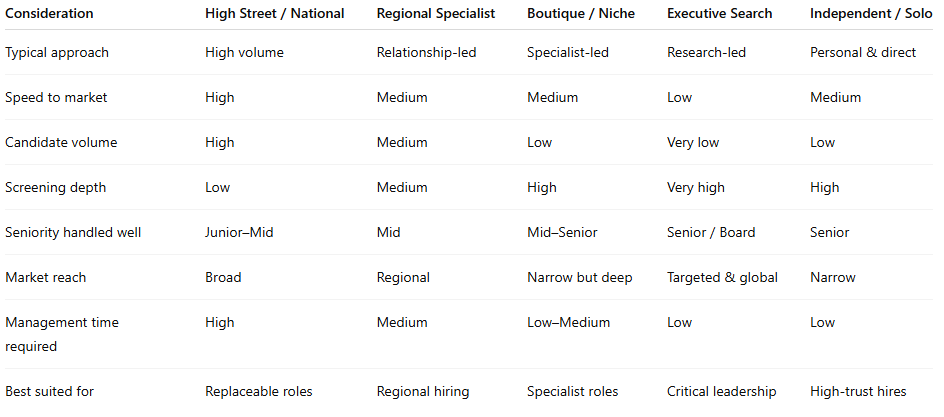
Recruiter models aren’t interchangeable. They are built with different trade-offs by design. Some optimise for speed and volume. Others optimise for depth, judgement, or confidentiality. None of them optimise for everything. Problems arise when a high-volume model is used for a high-risk role, or when a high-touch model is deployed where speed and simplicity would have been sufficient.
The cost of that misalignment doesn’t show up in fees. It shows up in: prolonged vacancies, excessive interviews, compromised decisions and leadership distraction.
Understanding the Common Recruiter Models
High Street / National Agencies
These firms are structured for scale. Large databases, repeatable processes, and speed to market. They work best when roles are replaceable and the cost of error is low. They struggle when roles require judgement, challenge or confidentiality. The trade-off is clear: speed in exchange for signal.
2. Regional Specialist Firms
Regional agencies often offer stronger local knowledge and more relationship-led delivery. They can be effective for mid-level roles within a defined geography. However, depth and reach vary significantly by consultant, and senior capability is inconsistent. The trade-off here is local insight in exchange for limited breadth.
3. Boutique / Niche Specialists
Boutiques are built for depth. They know the market they operate in and tend to screen more rigorously. They perform well on specialist or senior roles where understanding context matters. They are less effective where volume or immediate coverage is required. The trade-off is quality in exchange for speed.
4. Executive Search Firms
Executive search is research-led and risk-managed. It prioritises passive talent, confidentiality and leadership fit. This model exists for a reason: senior hiring failures are disproportionately expensive. It is not designed for urgency-driven or low-impact roles. The trade-off is time and cost in exchange for reduced leadership risk.
5. Independent / Solo Specialists
Independent recruiters offer direct accountability and personal judgement. They can be highly effective for critical individual hires where trust and discretion matter. Capacity constraints mean they do not scale well across multiple roles. The trade-off is intimacy and alignment in exchange for scale.
Why This Matters
From a finance perspective, recruitment fees are a rounding error compared to: the cost of vacancy, the cost of mis-hire and the cost of senior time absorbed by a broken process.
Most hiring inefficiency sits outside the P&L line item labelled “recruitment”. It sits in opportunity cost.
A Better Starting Question
Before choosing a recruiter, a better question is:
What does this role need to optimise for?
Speed?
Certainty?
Depth of judgement?
Confidentiality?
Clear answers usually make the recruiter model obvious.
Final Thought
Recruitment models aren’t good or bad. They are tools. Problems arise when the wrong tool is used for the wrong decision. Better hiring doesn’t start with more candidates. It starts with choosing the right route to market.